

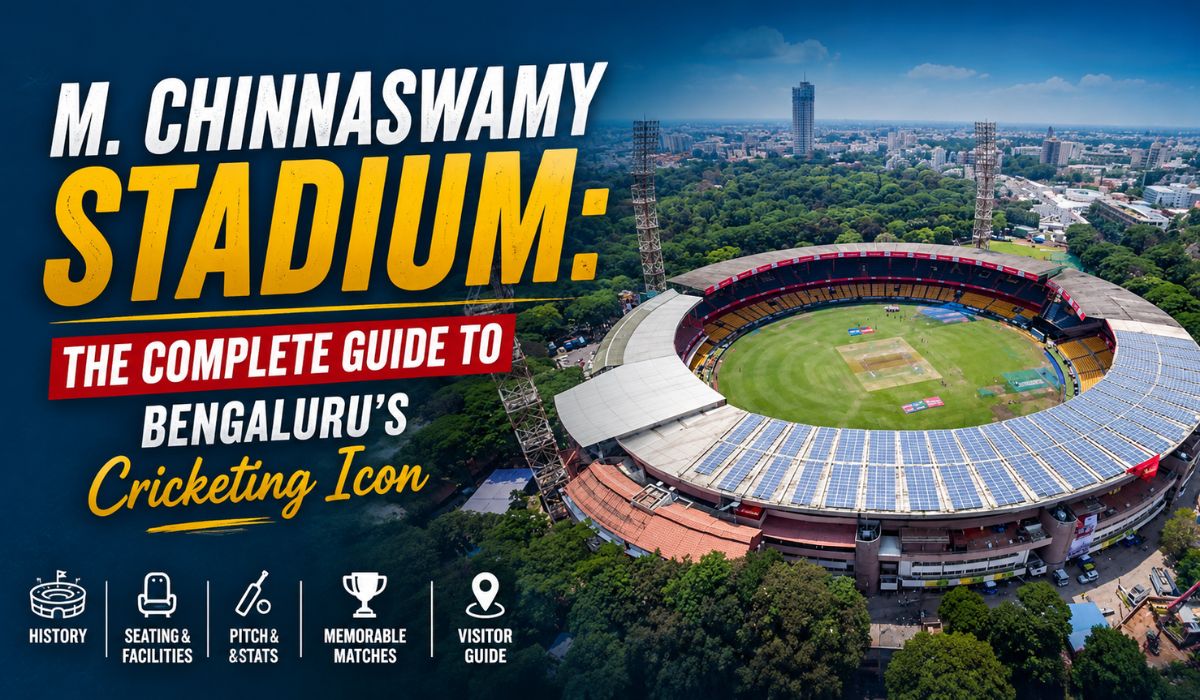
M. Chinnaswamy is recognised as one of the most iconic and cherished cricket grounds in India. M. Chinnaswamy stadium in the heart of Bengaluru, Karnataka has hosted historic Test debuts, World Cup clashes that became folklore and excitement-packed nail biting IPL thrillers. To millions of cricket lovers in the country and around the world M. Chinnaswamy Stadium is more than an arena; it is a place steeped in history, passion, and that electric atmosphere only generated by Bengaluru’s unique fans!
This article covers the history, architecture, records and cultural significance of M. Chinnaswamy Stadium with a few important facts, figures and frequently asked questions as well.
Overview of M. Chinnaswamy Stadium
M. Chinnaswamy Stadium is located on Mahatma Gandhi Road close to Cubbon Road Shivaji Nagar Bengaluru. Founded in 1969, the venue accommodates close to 40,000 spectators. The stadium is owned (under a 99-year lease) by the Karnataka State Cricket Association (KSCA; which owns many cricket grounds, including M Chinnaswamy Stadium). The ground is also the home-ground of Karnataka state cricket team and the Royal Challengers Bengaluru (RCB) franchise in Indian Premier League.
Earlier this stadium was named as Karnataka State Cricket Stadium and in 1996 the earlier name merged into the current M Chinnaswamy Stadium, which is named after former BCCI President M. Chinnaswamy. M. Chinnaswamy Stadium is one of the most famous sports places in South India and it still continues to attract thousands of fans every time a match takes place here.
History of M. Chinnaswamy Stadium
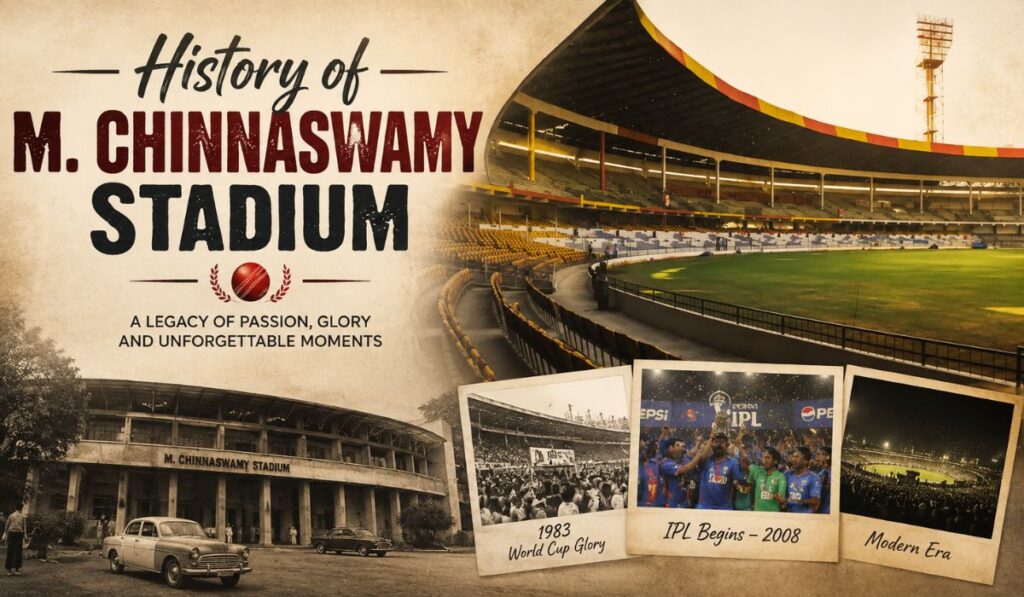
It was decades ago when Bengaluru had its own den to compete with the expanding love for cricket in the state of Karnataka, and that story begins with M Chinnaswamy Stadium. Ground itself begins to construct its stadium in 1970 and was officially inaugurated on November 1, 1974 with the first ever international match between India and West Indies. It was also a historic match as the legendary West Indian batter Sir Vivian Richards made his Test debut.
M. Chinnaswamy Stadium has played host to several landmark fixtures down the years. The outdoor stadium is best remembered for hosting the 1996 Cricket World Cup quarter-final between Indian and Pakistan when Venkatesh Prasad’s dismissal of Amir Sohail (also first day/night match at venue) became legendary. It has also been venue for events beyond cricket such as birthplace of the Miss World beauty pageant Joe Wright.
M. Chinnaswamy stadium has adapted to the times, too. It was one of the first venues in India to install floodlights, which were installed for the 1996 Cricket World Cup. The stadium also set the benchmark in sustainability by being the first Indian Stadium to have an installation of solar panels as well as eco-friendly drainage systems, paving the way for sustainable cricketing infrastructure throughout India.
Architecture and Unique Features
The defining characteristics of M Chinnaswamy Stadium are its circular design and compactness, which provides fans with an extremely close and electric experience. With its striking red exterior and a circular design that provides spectacular views of the cricket from any perspective, the stadium is an iconic part of the local area.
M. Chinnaswamy Stadium is also notorious for its short boundaries, one of the widely discussed aspects of it. The ground with above average batting pitches, short boundaries has always been the saleable venue for high-scoring thrillers and crunched finishes. The biggest reason behind this should be the fact that M Chinnaswamy Stadium became a favourite with power hitters, churning out some of the most prodigious individual and teams scores ever seen in cricket history like Chris Gayle’s unbeaten 175 made (the highest score recorded by any batsman in IPL history)
The stadium also has high-tech groundskeeping technology. It includes a modern vacuum power drainage system that is approximately 36 times faster than traditional systems, making the ground playable again after about 20 minutes of rain.
It is also the ground that houses a tribute to one of Karnataka’s all-time great cricket sons off the field, too. A 15-foot-wide and 27-foot-high wall built with 10,000 bricks pays a tribute of sorts to Rahul Dravid, a native product who went on to become world class batter.
Key Facts and Figures
Here is a summary table of important M. Chinnaswamy Stadium details in a table for easy reference:
| Detail | Information |
| Full Name | M. Chinnaswamy Stadium |
| Location | MG Road, Shivaji Nagar, Bengaluru, Karnataka |
| Established | 1969 |
| First Match Played | November 1974 (India vs West Indies) |
| Seating Capacity | Approximately 40,000 (capped at 35,000 in 2026 for safety reasons) |
| Owner | Government of Karnataka |
| Operator/Lessee | Karnataka State Cricket Association (KSCA) |
| Home Teams | Karnataka Men’s & Women’s teams, Royal Challengers Bengaluru (RCB) |
| End Names | Anil Kumble End, Rahul Dravid End |
| Known For | Short boundaries, batting-friendly pitch, solar power |
| Nearby Landmarks | Cubbon Park, UB City Mall |
(Capacity and safety information are subject to the latest stadium protocols; always confirm with official sources before planning a visit.)
International Records at M. Chinnaswamy Stadium
Over the decades, M. Chinnaswamy Stadium have hosted numerous international formats. The first men’s Test at the venue was played between India and West Indies on 22–27 November 1974, whereas the first men’s ODI came against Sri Lanka on 26 September 1982. It held its first men’s T20I on 25 October 2013, against Pakistan.
Some of the prominent international events related to M Chinnaswamy Stadium are enlisted in table below:
| Format | First Match | Notable Detail |
| Test | India vs West Indies, 1974 | Debut Test of Sir Viv Richards |
| ODI | India vs Sri Lanka, 1982 | Early World Cup venue |
| T20I | India vs Pakistan, 2012 | Modern format debut |
| Women’s Test | India vs West Indies, 1976 | Only women’s Test at the venue |
Also India hosted world cups in 1987 and 1996 that went onto happen here at M. Chinnaswamy stadium later, to make it one of the best international venues for cricket in India.
M. Chinnaswamy Stadium and the IPL
Nothing about M. Chinnaswamy Stadium’s modern identity is more synonymous though than its relationship with the Indian Premier League M. Chinnaswamy Stadium has been the host to some of the most entertaining encounters in IPL history, and as one of the most beloved grounds of all Royal Challengers Bengaluru. Some of the biggest batting legacies in IPL were build on this ground by explosive performances from Kings like Virat Kohli, Chris Gayle and AB de Villiers to name a few, M. Chinnaswamy ground has been a batting bonanza.
M. Chinnaswamy Stadium pitch is known as one of the most batting friendly pitches in world cricket. Analysts say that below 160 is a losing score but anything above 190 is a competitive one but in chaseable territory as spinners typically get more assistance in the second innings. These factors of shorter boundaries and flatter pitches have created a very friendly environment for runs and thus high scoring, crowd-pleaser matches at M. Chinnaswamy Stadium.
The most important thing is that RCB finally won their first-ever IPL trophy in 2025, making another glorious entry into the golden annals of M. Chinnaswamy Stadium history. But the celebratory atmosphere following that victory was blighted by a fatal stampede outside the stadium which led to the KSCA and local authorities implementing tighter security measures and a reduced capacity at the venue in future.
Recent Developments
M. Chinnaswamy has also made significant alterations to its configuration in recent seasons with a view to crowd safety and management. Caption Following smaller-scale 2025 title celebrations, the venue was restricted to 35,000 at following IPL season under new safety protocols after crowd unrest occurred in the aftermath and full venue capacity could be allowed again for later seasons. M. Chinnaswamy Stadium is still traditionally a first-choice venue for marquee fixtures, including playoff games and IPL finals with the easy acceptance by cricketing authorities of this ground, despite a temporary cut in its capacity.
Interestingly, RCB have also stretched their home-match footprint beyond M Chinnaswamy Stadium the franchise have split some of their home fixtures with venues outside Bengaluru for the first time ever, but continue to treat M. Chinnaswamy Stadium as an existing and primary home state, primarily its spiritual base.’
Getting to M. Chinnaswamy Stadium
M. Chinnaswamy Stadium, where the matches will be played is located centrally and well connected for fans planning to come. Visitors can also fly into the city, through Bengaluru International Airport, and then take a taxi or auto from the airport to the stadium; this journey would usually be about one hour & ten minutes. The MG Road Metro station is also nearby, while the location is near key attractions in Bengaluru such as Cubbon Park and UB City Mall, enabling a matchday at M Chinnaswamy Stadium to easily be coupled with sightseeing or dining around the city.
Why M. Chinnaswamy Stadium Matters
However, beyond the records and statistics, M. Chinnaswamy Stadium has a special place in Indian cricket. It is where local talent from Karnataka’s grassroots cricket structure has frequently found its way to the international big stage, and it where fans experience hard-core cricket, as few grounds in India offer with such passion. A major yet exciting environment like the M. Chinnaswamy Stadium continues to be an ongoing, living story in Indian cricket history from Test cricket achievements to IPL success where roar of the crowd is as vital a part of the experience as the game itself.
Be it a staunch RCB fan, an admirer of Test match history or just a cricket nerd who wants to know about India’s best stadiums,M. Chinnaswamy Stadium is a place that earns its spot inIndia’s hallowed sporting institutions.
FAQs
1. When was M. Chinnaswamy Stadium built?
M Chinnaswamy stadium first opened its doors in 1969, the construction of which began in 1970 International cricket was played by it for the first time in November 1974.
2. What is the seating capacity of M. Chinnaswamy Stadium?
Typically accommodates 40000+, the stadium has held up to approximately 35000 spectators since safety restrictions were put in place following liv inability title celebrations after IPL 2025.
3. Who owns M. Chinnaswamy Stadium?
The ground is owned by the Government of Karnataka and operated under a 99-year lease to the Karnataka State Cricket Association (KSCA).
4. Which IPL team plays its home matches at M. Chinnaswamy Stadium?
Royal Challengers Bengaluru (RCB) hosts its home IPL matches at M Chinnaswamy Stadium and the venue is an integral part of the franchise’s identity and fan culture.
5. Why is M. Chinnaswamy Stadium famous for high scores?
M. Chinnaswamy Stadium is famous for short boundaries and flat, batting-friendly pitch leading to high-scoring matches it has recorded some of the largest individual scores in IPL history.
6. What was the original name of M. Chinnaswamy Stadium?
The ground used to be called the Karnataka State Cricket Association (KSCA) Stadium before changing it to M. Chinnaswamy Stadium in honour of a former president of BCCI, M. Chinnaswamy.